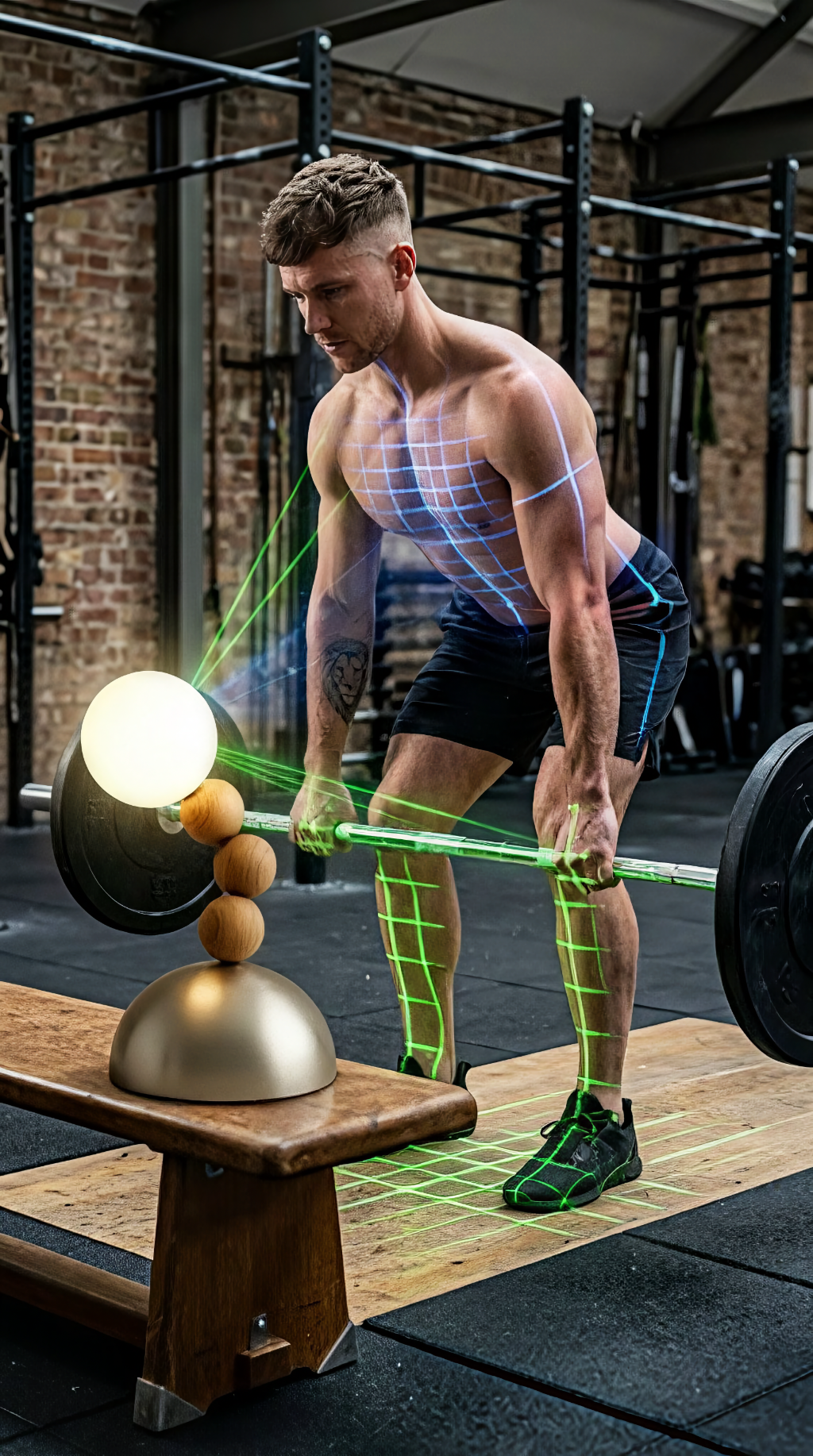
You've tried. Apps, programs, maybe a trainer for a while. None of it stuck.
You probably blame your discipline. The actual gap is the environment around you. The guys who get there have a coach who notices when their form breaks, a partner who texts when they bail, a fridge stocked the way it needs to be, someone in their life who cares whether they sleep. You haven't had any of that.
The work isn't one input either. Picking a path you'll actually show up to, putting clean technique under it, eating enough to recover, sleeping enough to grow, keeping stress from wrecking the rest. All parts of the same system, and none of them work alone.
Build the environment that threads them together and the body you want is a side effect of staying in it long enough.
Pick the path you love, not the optimal one
The path picks itself based on what you actually enjoy, not the optimal program the internet keeps trying to sell you.
Lifting, climbing, swimming, sprinting, cycling at intensity, bodyweight. They all build muscle and burn fat, and the differences are smaller than people pretend.
The one you stick with for two years is the one that changes your body. Most guys who tap out of "the optimal program" would have made more progress on a worse one they actually liked, because they'd still be doing it.
So pick what you love. If walking into a gym makes you want to leave, climbing will build more strength than lifting because you'll go four times a week instead of one. Lifting that bores you after the first month is the wrong sport, not the wrong program. Swimming counts on its own if you can do it for an hour without checking the clock. Beat-up knees push you toward swimming or biking. No gym time but you can run hills at lunch, run hills.
Variety is the whole point. The window of "objectively optimal" is small, and the window of "you'll actually do this for years" is the one that's hard to find. Pick that one.
Technique is the multiplier
Bad technique is the cheapest way to waste years of training.
You can show up, eat right, and sleep nine hours, and if your squat is dumping forward and your bench is bouncing off your chest, you'll get half the result for twice the wear. Technique is the multiplier on everything else, and it's free.
Full range of motion is where it starts. Squat below parallel, press to your chest under control, pull until your back is actually contracted, lock out fully on every rep.
Half-reps build half a result and hide weakness in the parts of the lift that matter most. If you can only do five clean full-range reps with a weight, that's your weight, not the eight ugly ones with the heavier load. Range you don't have is usually a mobility problem, not a strength one. The mobility and stretching guide covers that side.
Tension is the second piece. Slow the lowering phase to two or three seconds, control the bottom instead of bouncing out of it, drive evenly without using leg kick on a press or hip swing on a row.
The reps that look slightly slower than the gym bros next to you are usually the ones building something.
Paying attention is the third. Most lifters drift, on their phone between sets, with no real memory of what the bar felt like the last set, no idea whether their knees caved on rep four.
Recording one working set per session and watching it back is the cheapest coach you can get. Same goes for doing the lift in front of a mirror, or finding one person at the gym who actually knows the lift and asking them to watch a set.
The same logic carries across modalities. Climbing has footwork and body position, running has cadence and ground contact, swimming has a stroke that either pulls water or doesn't. The activity matters less than whether you're doing it well, and doing it well takes attention you can't fake.
The system that decides whether you get there
Picking the path and putting technique under it is the input side.
What your body does with the work depends on a connected system where four things have to hold together at once: stimulus, fuel, recovery, and stress. None of them work in isolation, because each one shapes the others.
Stimulus is the easy one. Push your body harder than what it's already adapted to. Heavier weights, longer holds, faster intervals, more reps with the same load. Anyone with two months of momentum gets this right.
Fuel is where most guys quietly fail. Building muscle takes a small calorie surplus (200 to 400 above maintenance) and roughly 0.7 to 1g of protein per pound of bodyweight every day. Skip either and the training produces nothing, no matter how hard you went.
Most guys who say "I lift hard but nothing happens" aren't lifting wrong, they're underfueling.
Diet doesn't sit on its own. Carbs around training keep sessions sharp, protein spread across the day fuels rebuilding, fat keeps your hormones in range. Eat too little and your testosterone drops, your sleep gets worse, your stress tolerance shrinks, and your training quality follows.
The fridge is doing more work than the gym most weeks. The guys who quietly look the way you want to look are the ones who figured that out. The full take on the kitchen side of this lives in the cooking and diet guide.
You don't need a tracking app forever, but you probably need one for two months so you actually know what you're eating. Most guys are off by 30% on protein and 50% on calories when they guess. After two months you'll have an eye for it. The eye gets built on the data.
Recovery is when the muscle actually gets built. Building happens in your sleep, not in the gym. Cut sleep and you flatten gains, raise cortisol, accumulate fatigue, and start skipping sessions.
You can train perfectly and eat perfectly and lose months because you're going to bed at 1am.
Sleep also feeds back into diet (a bad night cranks up your cravings the next day) and into training (one bad night drops your strength and reaction time noticeably).
Stress is the variable nobody tracks. Chronic stress raises cortisol, which suppresses muscle protein synthesis, pushes fat storage to your midsection, and drags sleep, diet, and training down with it.
The guy who lifts well and eats well but is running on financial or relationship anxiety will plateau and not understand why. Stress is a training variable like the others.
These four domains don't have separate scoreboards. You can't bank a great training week on top of a wrecked sleep week and call it even.
Training changes how much you eat, food changes how well you sleep, sleep changes how hard you can train, stress changes all three. The job is keeping all four roughly in the green at the same time, which is harder than it sounds when you're the only one watching.
You need feedback or you'll quit
The reason most guys quit isn't that the work is too hard. It's that they can't see whether it's working.
Train for two months with no signal back and your brain decides you're wasting your time. Three kinds of feedback have to land for you to keep going.
Feeling not alone. Other guys are doing this and felt just as awkward on day one as you. The ones who couldn't squat to depth at first got there too. Without that signal you quietly decide you're the broken one and quit.
Feeling you can do it. Knowing roughly when you'll see the change you're after, and what milestones say you're on track. "Abs by July, here's what week 4 should look like" is the kind of forecast that keeps you going. Without it every week feels like maybe-yes-maybe-no, and your brain picks no.
Feeling you can choose. The courage to try things, swap programs, walk into a climbing gym for the first time, ask a stranger to spot you. That courage runs on "I won't get hurt if this doesn't work." Without it you stay in the safest version of your routine, which is also the one that doesn't change anything.
These three are what good coaches and good partners actually deliver, and it's why the guys with that environment stick. The work itself is the same for everyone, the staying-in-it is the difference.
Find the people
The guys who succeed don't have more discipline, they have people around them who notice.
A training partner who texts when they're flat, a coach who spots form changes before they catch them, a friend who chases them when they bail, a community where showing up is just what people do. They're not lifting alone, eating alone, or sleeping in a vacuum.
You won't manufacture this overnight, and you don't need to. Pick one place (a gym, a climbing crag, a running club, a Saturday morning park crew) and become a regular. Tell two friends what you're working on. Anchor one weekly slot where another human is expecting you.
The hardest part of community is showing up enough times that somebody learns your name. A year in, you'll forget how you ever did this alone.
Set up the rest of your environment
The other half of environment is the stuff in your space, the things willpower can't out-run.
Food at home. If your fridge is empty after a long day you'll order in, and if you order in regularly enough you stall. Block two hours on Sunday and prep three meals you can pull from. You don't need to cook like a chef, you need food in the fridge when you're tired.
A sleep window you defend. Pick a bedtime and protect it from the things that erode it. Phone out of the bedroom, last meal three hours before, lights down an hour before. Half-following this is enough that your sleep stops being a coin flip.
Visible track. Write your sessions, your meals, and your sleep in one place. The weeks you only got two sessions in are obvious, and so are the months you actually stuck. You can't fix what you can't see.
A note on programs
You're going to ask which program to actually run.
Programs matter less than you've been told. Starting Strength, GZCLP, PPL, 5/3/1, anything with progressive overload baked in works if you finish it.
Pick whichever fits your life. Three days a week if that's all you can sustain, six if you can. Lift heavy enough to be uncomfortable, eat enough to recover, sleep enough to grow, and keep doing it for two years instead of two months.
You don't need to optimize the program before you start, you need an environment that keeps you in the game long enough that any of these programs work.
That's the thing that's been missing.