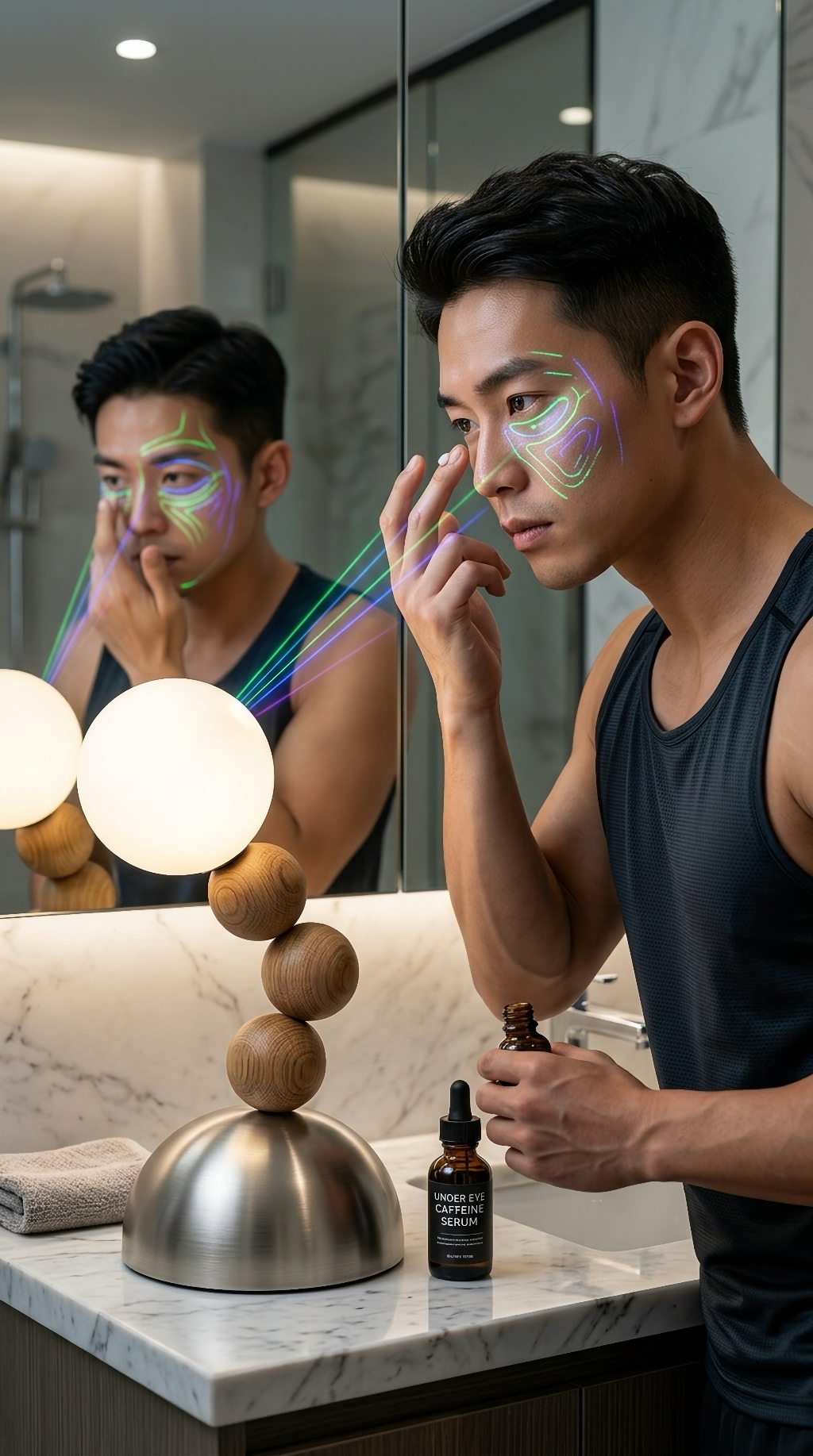
You've tried. A retinol, a vitamin C, a fancy moisturizer your friend swears by, a dermatologist for a month. The breakouts come back.
You probably blame your skin. The actual gap is the environment around you. The guys with clear skin sleep enough, eat real food most days, drink enough water, manage stress somehow, and have a routine they actually run twice a day. You haven't had all of that at once.
The work isn't one input either. Picking a routine you'll actually run, applying products well, eating in a way that doesn't break you out, sleeping enough for the skin to repair, keeping stress from spiking your cortisol. All parts of the same system, none of which work alone.
Build the environment that threads them together and the skin you want is a side effect of staying in it long enough.
Pick the routine you'll actually run
The routine picks itself based on what you'll do twice a day, not the optimal twelve-step plan the internet keeps trying to sell you.
Three steps (cleanser, moisturizer, SPF), five steps with a serum and an exfoliant, ten steps if you're into it. They all build clear skin, and the differences are smaller than people pretend.
The one you'll do every morning and every night is the one that changes your face. Most guys who tap out of "the optimal twelve-step routine" would have had clearer skin on a worse three-step plan, because they'd still be doing it.
So pick what you'll run. If your bathroom has fifteen products on the counter and you don't know which is which, you've picked the wrong stack for you. Three products you use twice a day beat fifteen you use sometimes. Sensitive skin keeps you basic. Liking the ritual lets you build it out. The best routine is the one your hands do without you thinking about it.
Variety is the whole point. The window of "objectively optimal product stack" is small, and the window of "you'll actually run this twice a day for years" is the one that's hard to find. Pick that one.
Technique is the multiplier
Bad application is the cheapest way to waste expensive products.
You can buy the right cleanser and the right serum and the right sunscreen, and if you're using a teaspoon of SPF on your whole face and rubbing your retinol into eye skin until it stings, you'll get half the result for twice the irritation. Technique is the multiplier on everything else, and it's free.
Application order is where it starts. Lighter products first, heavier products last. Cleanser, then thin serums, then thicker creams, then SPF. Skipping the order means the SPF can't sit where it needs to.
The moves that look slightly more deliberate than the routine you've been running are usually the ones building something.
Amount is the second piece. Most guys under-apply. SPF needs two finger-lengths to actually protect your face. Moisturizer needs a coin's worth, not a pinhead. Retinol needs a pea, not a smear.
Under-dosing your sunscreen is the most expensive mistake in skincare. You get half the SPF rating you paid for and the rest of the routine starts to fall behind UV damage that's still happening.
Gentleness is the third. Pat, don't rub. Use lukewarm water. Don't exfoliate every day. Leave anything that hasn't surfaced alone.
Skin damage from over-use of actives is the slow-motion version of under-doing prep on a heavy lift. It catches up.
Recording yourself doing one application per week and watching it back is the cheapest coach you can get. Same goes for asking a partner whether you're missing your jawline, your hairline, the tops of your ears.
The same logic carries across products. Retinol has tolerance, vitamin C has timing, BHA has frequency. The product matters less than whether you're using it well, and using it well takes attention you can't fake.
The system that decides whether your skin clears
Picking a routine and putting technique under it is the input side.
What your skin does with the products depends on a connected system where four things have to hold together: products, diet, sleep, and stress. None of them work in isolation, because each one shapes the others.
Products are the easy one. Cleanse, moisturize, SPF in the morning, retinol at night a few times a week. Anyone with a stocked shelf and a rhythm gets this right.
Diet is where most guys quietly fail. Sugar, ultra-processed food, and dairy spike inflammation in some people, and inflammation shows up on your face. Hydration matters. Real food matters.
Most guys who say "I use everything and my skin still breaks out" aren't applying wrong, they're feeding the breakouts from the inside.
Diet doesn't sit on its own. Eat too much sugar and your sleep gets worse, your hormones swing, your skin oils up, and your routine starts to lose ground. Eat the right things and your skin stops fighting you. The kitchen side of this lives in the cooking and diet guide.
The fridge is doing more work than the cabinet some weeks. The guys who quietly look how you want to look are the ones who figured that out.
You don't need a food log forever, but you probably need one for two months so you actually know what you're eating. Most guys can spot two or three foods that consistently break them out if they pay attention. After two months you'll have an eye for it.
Sleep is when skin actually repairs. Skin barrier repair, cell turnover, and inflammation control all happen in deep sleep. Cut sleep and you flatten the routine, raise cortisol, push oil production up, and start seeing breakouts for no obvious reason.
You can use the perfect routine and lose months because you're going to bed at 1am.
Sleep also feeds back into stress (a bad night cranks up reactivity the next day) and into diet (a bad night spikes sugar cravings).
Stress is the variable nobody tracks. Chronic stress raises cortisol, which jacks oil production, drives stress acne (especially on jaw and chin), and slows healing. The guy who runs the perfect routine but is running on financial or relationship anxiety will plateau and not understand why.
Stress is a skin variable like the others.
These four don't have separate scoreboards. You can't bank a great products week on top of a wrecked sleep week and call it even.
Routine changes how your skin handles the rest, diet changes what it fights, sleep changes how it repairs, stress changes everything. The job is keeping all four roughly in the green at the same time, which is harder than it sounds when you're the only one watching.
You need feedback or you'll quit
The reason most guys quit a routine isn't that the work is too hard. It's that they can't see whether it's working.
Run a routine for two months with no signal back and your brain decides you're wasting your time. Three kinds of feedback have to land for you to keep going.
Feeling not alone. Other guys are doing this and felt just as self-conscious carrying a moisturizer in the bathroom as you. The ones who broke out worse before they got better got there. Without that signal you quietly decide you're hopeless and quit.
Feeling you can do it. Knowing roughly when your skin will clear, and what milestones say you're on track. "Clear by July, fewer breakouts by month two, retinol-tolerant by month three" is the kind of forecast that keeps you going. Without it every breakout feels like proof the routine isn't working.
Feeling you can choose. The courage to swap products, drop one that isn't working, ask a dermatologist a stupid question, walk away from the brand your friend swears by. That courage runs on "I won't damage my skin if this doesn't work." Without it you stay in the safest version of your routine, which is also the one that doesn't change anything.
These three are what good partners and good dermatologists actually deliver, and it's why the guys with that environment stick. The products themselves are the same for everyone.
Find the people
The guys with clear skin don't have more discipline, they have people around them who notice.
A partner who tells them when their skin is glowing or dropping, a friend who'll text them about a new product, a dermatologist who actually remembers their face, a barber who comments on their jaw. They're not running the routine in a vacuum.
You won't manufacture this overnight. Pick one person to update on what you're trying. Book one dermatologist appointment. Tell a friend you're working on your skin and you'll send them a photo in three months.
The hardest part is showing up consistently enough that someone notices the change. A year in, you'll forget how you ever ran the routine alone.
Set up the rest of your environment
The other half of environment is the stuff in your space, the things willpower can't out-run.
Products at the sink, not in a drawer. If your routine requires opening three cabinets, you'll skip nights. Lay your AM and PM products in line, in the order you use them. Visible products get used.
An AM and PM rotation that runs on autopilot. Cleanser, moisturizer, SPF in the morning. Cleanser, retinol or serum, moisturizer at night. Same products, same order, every day until your hands move on their own.
Visible track. Take a photo of your face every Sunday. The weeks your skin slipped are obvious, and so are the months you actually built something. You can't fix what you can't see.
A note on products
You're going to ask which exact stack to actually buy.
Products matter less than you've been told. CeraVe, La Roche-Posay, The Ordinary, the mid-tier dermatologist brands, the high-end ones. Most of them work if you finish them.
Pick whichever fits your life and your skin. Three products if that's all you'll run, six if you'll do it. Use what works, eat well enough that your skin can keep up, sleep enough to repair, and keep doing it for two years instead of two months.
You don't need to optimize the product stack before you start, you need an environment that keeps your hands moving twice a day until any of these stacks work.
That's the thing that's been missing.